
Practical guide
Chores for Kids: Find a Workable Starting Point
Prepared by BondSeed • Published Nov 2, 2026 · 6 min read
Quick answer
Choose a job your household needs, then find a part your child can safely practice. Age lists offer ideas; experience, reachable materials and available adult help determine the arrangement. Start with a step card for learning the actions, or a task plan for agreeing on a routine.
On this page
Start with a job your household actually needs. No pet means no pet-feeding chore. A child who shares a room can look after one agreed space rather than take responsibility for everyone’s belongings.
Chore ideas by age, with room to adjust
| Age | A starting idea | The adult’s part |
|---|---|---|
| 4–5 | Join in: put used toys in a basket or bring napkins. | Work alongside; point out what goes where. |
| 6–7 | Practice a small job: put out napkins or match a few pairs of socks. | Prepare the materials and show the actions. Try the step cards below. |
| 8–10 | Practice a familiar job from start to finish, such as putting clean clothes away. | Agree on the storage places and finish point; stay available for help. |
| 11–13 | Plan a familiar job, such as changing bedsheets or checking which table linens need washing. | Teach unfamiliar parts, check safe handling and agree on a workable time. |
The AAP and AACAP group their chore suggestions somewhat differently. Use age lists for ideas, then check the actual task, equipment and help available. An older child learning a job for the first time can use smaller steps too.
One household job can have several starting points
Take clean laundry. A child learning to sort can match a few socks with you. One who knows how can put their pairs in the right drawer. A child familiar with both parts can agree on when to put away a small basket of their already-sorted clothes. These are ways to divide the job, not a sequence tied to birthdays.
Before handing it over, sort out the practical obstacles. Who owns the clothes? Where do they go? If the drawer is full or the hangers are out of reach, repeating “Put them away” leaves the same problem in place. Clear a space or choose another part of the job.
Keep hazardous parts with an adult: hot pans, sharp or breakable objects, strong cleaners, heavy loads and climbing. For table wiping, a damp cloth is a useful starting point; an adult handles cleaning products and any needed disinfection. Poison Control’s guidance covers labels, secure storage and avoiding mixed cleaners.
Leave power mowing off young children’s lists. The AAP recommends minimum ages of 12 for walk-behind power mowers and 16 for riding mowers, along with suitable judgment, physical ability and instruction. Reaching that age alone does not establish readiness.
Choose a printable for the problem in front of you
If your child is still learning the actions, start with the step cards. If they know the job and you need to agree on who does what and when, use the task plan. Both packs are free, with no sign-up, in English and Chinese, A4 and US Letter. The previews show the actual PDFs.
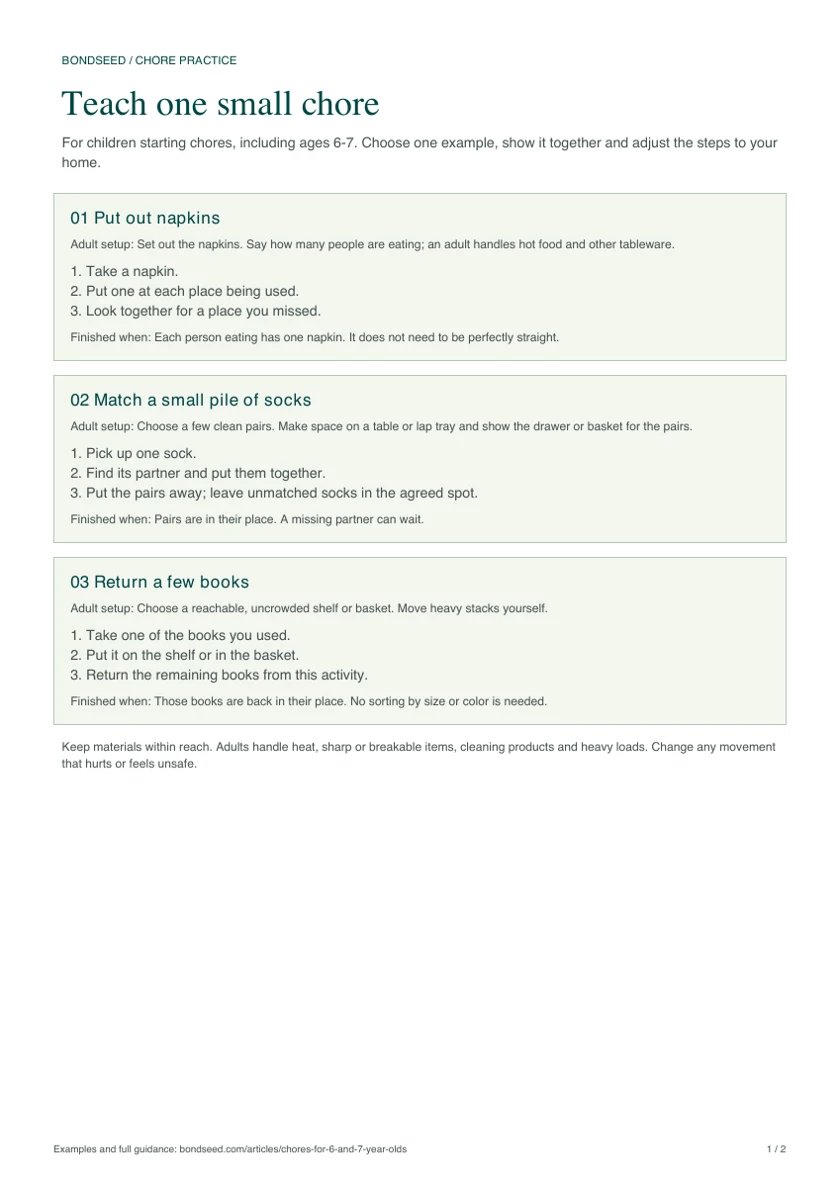
Step cards for a first chore
For learning the actions: three example step cards, a blank card and a record of where help was needed.
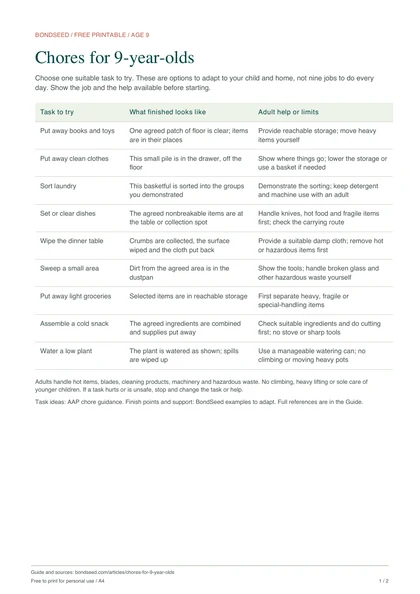
Printable chore options and a one-task plan
For agreeing on a routine: nine chore options with finish points and adult help, plus a one-task plan.
Use one sheet that fits the difficulty. You can also copy the parts you need onto scrap paper. A bigger chart does not solve an unclear request or a tool your child cannot use.
Sharing chores between children
Write down the adult’s part as well as the children’s. For example, before dinner one child could put out napkins, another could bring nonbreakable cups, and an adult could set the cups within reach and serve the hot food. Give each person a clear part before judging whether the work is evenly shared.
Let children choose between jobs that really are interchangeable. Teach a new part before rotating it. Check the effort involved: two small jobs may take less work than one larger job, and the child who finishes quickly need not become the default helper for everyone else.
If “Why is it always me?” keeps coming up, look at recent jobs, including unplanned help. Our guide to unfair-feeling arrangements can help you review the split. You do not need a long family meeting to divide the work for one meal.
After trying it, decide what needs to change
Look at where adult help was needed. If the job never started, check the cue and the timing. If it stopped halfway, check the steps, materials and tiredness. If you keep redoing it afterward, check whether you explained the finish point before your child began.
Try changing one practical detail, such as keeping the basket in the same place. Changing the time, the task and the amount all at once makes it harder to see which part needs attention. Reduce the load when illness, tiredness or changes at home call for it.
You do not need a points system before teaching a job. Families handle allowance differently; the Raising Children Network describes several approaches. If you offer payment for an extra job, agree on the work, the finish point and what you can afford before it starts. If difficulties persist or worsen, talk with your child’s pediatrician rather than relying on more charts.
For today, choose one small job you have time to demonstrate. The first-chore guide walks through what to say and what to do when a step goes wrong.