
Practical guide
When Grandparents Undermine Your Parenting Rules
By BondSeed • Published Aug 27, 2026 • Updated Oct 9, 2026 · 8 min read
Quick answer
If a child has heard two answers, give a clear answer for now and let the adults handle the disagreement. Speak privately about the specific event, distinguish safety needs from preferences, and ask what the grandparent can realistically manage. Repeated failures around health or safety need a safer care arrangement, not just a better explanation.
For example, you agree that the tablet goes away at nine. A grandparent gives it back at ten and asks your child not to mention it. You are upset about the extra hour, but also about the secrecy. Start there, with what happened, rather than trying to settle who is the better parent.
In that moment, the tablet rule can feel like a verdict on your parenting. The grandparent may feel that hours of real care have been reduced to a list of corrections. Your child has two answers and may now be expected to choose, report, persuade, or hide. That three-person bind is the part to change first.
What to say while your child is standing there
The first goal is not to prove who has authority. It is to show your child that adults will handle adult communication.
“We gave you different answers. The tablet goes away now. Grandma and I will sort out tomorrow’s plan.”
If your child acted on permission a grandparent gave, begin with the information gap: “You were told yes, so you thought it was settled. I will check with Grandpa. You do not need to carry messages between us.” Do not begin by accusing your child of finding the easier adult.
If your child knowingly concealed an earlier no, you can address honesty later. That is a separate issue. It does not remove the adults' job of giving clear handoffs.
Not every difference needs the same response
Start by deciding what the rule protects. Health instructions need accurate handoffs; ordinary routines need enough clarity to be workable; preferences can sometimes differ. For teens, CDC guidance on independence supports clear expectations with increasing input. That principle does not require identical snacks or schedules in every household.
Safety, health, and accurate handoffs
Allergies, medication, car seats and seat belts, pickup permissions, water supervision, driving, substance use, and unsafe online contact need a clear plan across caregivers.
Next move: Write the exact instruction, emergency contact, and what the caregiver should do if the plan cannot be followed.
Recurring rules that need a workable handoff
Bedtime, devices, homework, curfews, money, and chores may need enough consistency that the child can predict what happens next.
Next move: Agree on the smallest fixed limit, who follows through, and which details the grandparent may adjust.
Preferences that can be different
Dessert, games, clothes, table customs, and the pace of a relaxed afternoon do not always need to match from one home to another.
Next move: Let the difference be open and predictable: “Grandpa's house has a different snack routine. We return to our routine at home.”
A known difference can be manageable: “At Grandma's, dessert comes after dinner. At home, we usually save it for weekends.” A hidden reversal is different. Secrecy and surprise make it harder for a child to know which answer is real.
Before the conversation, make the rule smaller
“Please respect my parenting” is emotionally understandable, but it does not tell anyone what to do at 9:05 p.m. Choose one repeated situation and write the behavior in plain language.
Replace “Do not undermine me about screens” with: “Sunday through Thursday, the device charges in the kitchen at nine. If she asks for more time, please text me before saying yes. If I do not answer, the nine o'clock plan stands.” Now both adults can see whether the plan happened and where it broke.
Also check whether the rule fits the care you are asking someone else to provide. If a grandparent handles school pickup, dinner, homework, and bedtime four nights a week, a long list of detailed instructions may collapse at the busiest point of the evening. Ask which one or two limits matter most, what you will take back, and what the grandparent can decide in their own home.
Speak privately about the one event. You might say, “You handle dinner and the late pickup, and I know nine is a difficult time. But I don't want her keeping a rule change secret. What needs to change at handoff?” Listen for missing information, an impractical arrangement or a disagreement that still needs resolving.
With a younger child, give one clear answer for now and tell them the adults will talk. With a teen, also ask for facts that could change the plan—such as when the activity finishes or which ride is available. Neither child has to mediate between you.
Write a three-line caregiver agreement
Repeated conflicts rarely need a family constitution. They need a brief handoff that an adult can remember during a busy afternoon:
Fixed: Follow the child’s written medication instructions; clarify any uncertainty with the clinician or pharmacist.
Flexible: Grandpa chooses whether dinner or the shower happens first.
If we disagree: We contact each other. The child does not carry the message or keep the change secret.
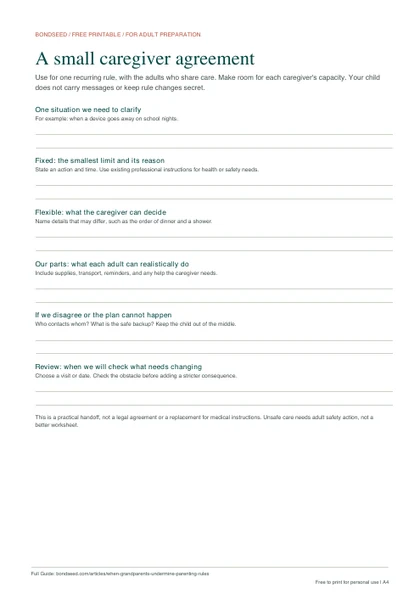
Free printable · 1 page · For adult caregivers
A small agreement for parents and grandparents
Write one fixed limit, what can vary, and how the adults will handle a disagreement. Keep your child out of the middle.
No account needed. Print only what you need; leave out identifying details you do not need.
Prepare your family agreementReview the plan after a week or after the next visit. If it failed, look for the exact obstacle before adding a threat. The limit may be unclear, too broad, or missing the adult who was supposed to take over.
Be precise about “our little secret”
A time-limited surprise is different from a secret that protects an adult from accountability. A grandparent and child can hide a birthday gift until Saturday. A child should not be asked to conceal medication, food that affects an allergy, whereabouts, device accounts, punishment, injury, adult contact, or anything frightening or uncomfortable.
“If anyone asks you to hide something about safety, your body, medicine, where you went, or something that made you scared or uncomfortable, you can tell me. You will not be in trouble for telling.”
Make this a general family safety rule, not a request to monitor a particular grandparent.
If the pattern continues
Match your next step to what is happening. If the agreement was misunderstood, shorten it and put it in writing. If the grandparent cannot carry it out, change the schedule, supplies, pickup, or parent handoff. If they understand and repeatedly refuse, change the responsibility connected to that rule when you reasonably can.
For example: “Because the allergy plan was not followed, I cannot leave meals unplanned. I will pack the food, and visits involving meals will be with me for now.” That is a safety arrangement, not a punishment designed to make a grandparent suffer.
Many families rely on grandparents for housing, transportation, cultural connection, or essential care, and an immediate alternative may not exist. Start with the few safety boundaries that truly cannot move. Reduce preference-based demands. A family counselor or another trusted facilitator may help adults discuss one concrete recurring problem. For a medical issue, ask the child's clinician to explain the actual care instructions; do not recruit a clinician as a judge for every family value dispute.
Grandparents' homes do not have to copy yours
A grandparent who welcomes a child into their home may have legitimate house rules too: shoes stay by the door, a quiet hour begins at ten, or certain rooms are private. Their health, energy, work, and willingness to provide care matter. A respectful agreement names both sets of responsibilities instead of treating the grandparent as either an employee or a visitor with no voice.
Colorado State University Extension's guidance for grandparents raising grandchildrensimilarly recommends honest conversations about caregiving limits, expectations, roles, and responsibilities. That is why this conversation should include capacity, not only authority.
If a grandparent is the child's primary or legal guardian, or the family is living under a court, kinship-care, foster-care, or custody arrangement, the decision-making structure may be different. Use the real care agreement and qualified local legal advice. A general parenting Guide cannot decide legal authority.
Family harmony does not outrank safety
This Guide is for ordinary caregiving disagreements. If a grandparent or any caregiver hits, threatens, humiliates, forces secrecy, blocks someone from leaving, ignores essential medication or allergy information, or makes the child feel unsafe, do not preserve politeness at the child's expense. Stop the harm, move the child to safety when you can, and contact appropriate local medical, child protection, domestic violence, crisis, or emergency support.
When abuse or coercive control may be present, do not require the person being harmed to negotiate alone with the person causing harm.
When two adults have already given different answers
Read the next Guide when that is the problem you need to solve.
For a calmer moment, try this related conversation. To practice the skill over time, see Course Chapter 6 (membership required).
Put the ideas into practice
Tools for this moment
Choose one action that fits. Each free tool includes instructions, examples, and a worksheet to prepare your own words.
- Stand Beside Your Child Your child needs support in a disagreement, an uncomfortable request, or a conversation with another adult.“I want to understand what happened. My child needs a chance to explain, too.”
- Make a Workable Family Agreement A recurring rule needs to become a clear agreement.Write the rule, each person's part, and what you will do if the plan breaks.