
Practical guide
How to Get Beyond One-Word Answers After School
By BondSeed • Published Oct 26, 2025 • Updated Oct 9, 2026 · 6 min read
Quick answer
Give your child a break before asking about school. Try one question about a small moment, and accept a short answer or a pass. Handle necessary school arrangements separately; sharing a story is optional.
You have been wondering about your child all day. Then “How was school?” gets “Fine,” and the conversation ends. Wanting another detail is understandable, especially when your time together is limited. But a school check-in does not have to produce a full report. These suggestions offer a way to invite one story; your child may still give a short answer or prefer not to talk.
Free printable · 2 pages · Ages 6–12
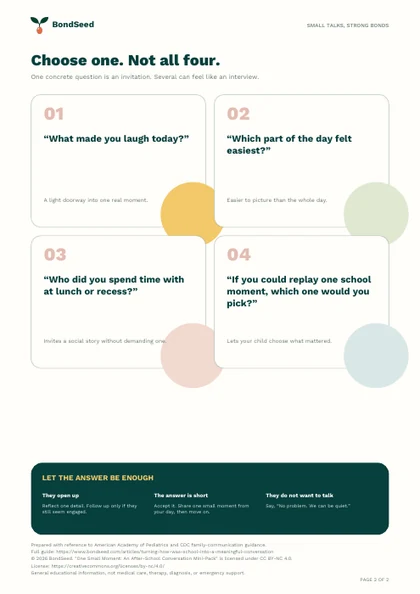
Four after-school conversation cards
For ages 6–12: choose one question after your child has had time to settle. The second page helps you respond; a short answer is enough.
No account needed. Print only what you need; leave out identifying details you do not need.
Prepare one inviting question Read how to use the cardsWhat “fine” does—and does not—tell you
“How was school?” covers several hours. Your child might not know where to begin, might want a break, or might mean exactly what they said. One word alone does not tell you that something is wrong, that they are rejecting you, or that you asked badly. You do not need to correct their attitude or immediately find a better question.
Three steps for a small invitation
1. Let your child land
The American Academy of Pediatrics advises giving tired school-age children time to rest or have a snack before talking, and choosing a quiet, private setting. That guidance is for ages 5–12. Start with ordinary care; food and rest remain available whether or not your child shares a story. If they are crying, shouting, or unsafe, attend to those needs first. The Guide on after-school meltdowns covers that arrival period.
If there is no quiet room, save personal questions for a more private moment, perhaps while doing a chore together. If you get home late from work, you do not owe anyone a catch-up interview. A little ordinary company can be all you have time for today.
2. Ask about one moment
Try one question about a part of the day. These are examples to adapt, not a set to work through when the first answer is short.
Ages 6–12
- “What made you laugh today?”
- “What did you play at recess?”
Use familiar words and your child's usual way of communicating. Showing you something, drawing, using a communication aid, or passing are options too.
Ages 13–18
- “What took the most energy today?”
- “Want to tell me one good, annoying, or strange moment?”
Let your teen choose what to share and how much. Telling a friend something does not mean they owe you the same account.
For a calm moment when your child wants to look back on the day, try the optional Replay One Moment Talk. It has prompts for both age groups. Do not use it as another question they must answer after declining this one.
3. Reflect before you follow up
CDC guidance recommends listening without interrupting, then checking that you understood before asking more. Stay with what your child actually said. A reflection can be a brief fact; you do not have to decide which feeling lies underneath it.
For example, a correction can be the end of the exchange:
Child: “Our groups are changing again.”
Parent: “You changed groups today?”
Child: “No, next week.”
Parent: “Oh, next week. Got it.”
Accept the correction without explaining why your guess made sense. If your child continues, listen; if they stop, let the conversation end. For more practice with this response, see How to Listen So Your Child Feels Understood.
What to do with the answer you get
If they open up
Follow that story without adding every question you have saved about grades or homework. If there is a problem, ask whether they want listening, ideas, or practical help. An immediate safety concern still needs adult action; do not wait for a complete account before protecting your child.
If the answer is still short
Accept it. You can share a small moment from your own day if it fits, but do not make that a trade: “I told you mine, so tell me yours.” There is no need to reward a longer answer or criticize a short one.
If they do not want to talk
“Okay, we can leave it there” is enough. Continue ordinary care and company without following them from room to room. Your teen may also choose another trusted person to talk with. If you feel shut out more generally, use My Child Won't Talk to Me.
If you also notice ongoing changes in sleep, friendships, or activities, see My Child Says “I'm Fine” but Seems Upset. For concerns about emotional well-being, CDC advises contacting a qualified professional, such as your child's healthcare provider. More questions are not a substitute for that support.
Keep school administration separate from connection
Pickup changes, forms, and real deadlines may need attention even when your child does not want to describe the day. Name the task directly: “The trip form is due tomorrow. Let's find it.” If they cannot remember where it is, help look or check the school message. Get the information needed for that task without using it to start questions about friends or feelings.
If several adults collect your child, pass on essential logistics so they do not each ask for a report. A personal story is not automatically material for the family group chat; ask before sharing it. Where protection requires involving another adult, share what that person needs to help, and explain this to your child when possible.
Next time, try changing just the timing: offer ordinary company first and invite a story later if there is room. Notice whether you can accept a short exchange; do not count answers or keep a streak. If a specific issue needs another conversation, plan a manageable follow-up. If you miss it, acknowledge that and arrange what you can actually do.
To practice open questions and reflective listening beyond this situation, Course 3: Ask and Listen is a member course. The steps above are complete without joining.
Put the ideas into practice
Tools for this moment
Choose one action that fits. Each free tool includes instructions, examples, and a worksheet to prepare your own words.
- Ask an Inviting Question You want your child's perspective and are willing to hear an answer different from yours.“I see it differently, and I'd like to understand your view. Is now a good time?”
- Follow One Detail Your child offers a detail and seems open to continuing.Pick a word they used and ask one gentle follow-up.