
Practical guide
How to Have a Family Meeting Without a Lecture
By BondSeed • Published Aug 29, 2026 • Updated Oct 9, 2026 · 6 min read
Quick answer
Choose one practical issue and tell everyone what their input can change. Give each person room to speak, pass or contribute another way. Finish with one workable trial and a time to review it; private disclosures, punishment and adult relationship disputes do not belong in a family meeting.
Imagine being called to a family meeting without knowing the topic. The adult explains the decision for ten minutes, asks what you think, then argues with every answer. You would have good reason to wonder what the meeting was for.
Before calling everyone together, decide what their input could actually change. Chore order, a shared-room routine or a difficult morning can be useful topics. A child's private health concern, an apology or an adult relationship dispute needs a smaller conversation.
If the issue is a week that no longer fits together, start by looking at the whole family schedule, including travel and care. That can show which conflict needs a decision before you call a meeting.
Choose the meeting before you choose the agenda
Families often mix three different jobs into one conversation. Separate them before anyone sits down.
A decision meeting
Some parts can genuinely change after family members share obstacles and ideas.
“The kitchen needs to be usable by nine. We can decide who does which part and whether the jobs rotate.”
An information meeting
An adult has already made a safety, legal, medical, budget, or scheduling decision. The meeting explains what happens and invites input only on real choices.
“We can only afford one paid activity next term. We can look at the choices together.”
A private conversation
One person's behavior, hurt, privacy, or disclosure should be handled with the people directly involved—not discussed before an audience.
“This concerns you and me. We will talk privately instead of asking the family to weigh in.”
Tell people the topic and end time beforehand. For ages 6–12, one concrete issue and two genuine choices may be enough: “Blocks first or books first?” Teens can suggest a different division of chores, send an idea in writing or ask for a time that does not clash with their plans. Do not present sibling care as a decision they can influence only after you have volunteered their time.
A short agenda to adapt
The University of Delaware's family-meeting guidance supports short meetings, one issue at a time and room for different ways of contributing. The example timing below is ours: shorten it, skip an unnecessary step or pause when the family needs to. It is not a tested twenty-minute formula.
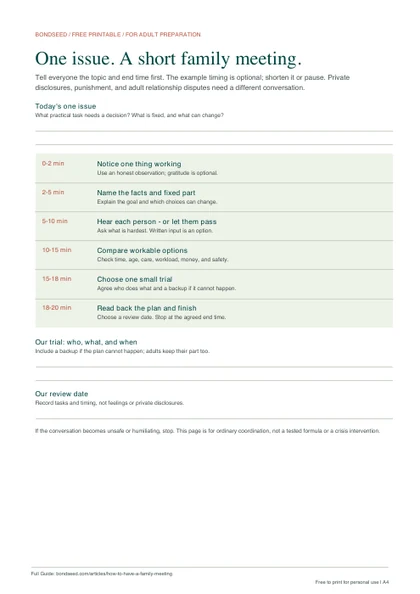
Free printable · 1 page · Adapt for ages 6–18
A family meeting agenda to make your own
Keep one issue in view, leave room to speak or pass, and finish with a small trial and a review date. Shorten the example timing if needed.
No account needed. Print only what you need; leave out identifying details you do not need.
Prepare the agreement together0–2 minutes
Name one thing that is working
Start with an accurate observation, not forced gratitude: “Putting breakfast dishes straight into the dishwasher made mornings easier this week.”
2–5 minutes
State the facts, goal, and fixed part
“Dinner cleanup has had no clear owner. The goal is a usable kitchen by nine. Cleanup is fixed; the jobs, order, and rotation are open.”
5–10 minutes
Let each person speak—or pass for now
Start with “What is hardest about this?” Give each person time before asking for suggestions. Do not interrupt, correct, or cross-examine.
10–15 minutes
List options and test them against reality
Look at age, time, health, workload, money, and safety. A midpoint is not automatically fair if it still fails to solve the problem.
15–18 minutes
Choose one short experiment
Name who will do what, by when, and how they will communicate if the plan cannot happen. Try it for a defined period instead of announcing a permanent system.
18–20 minutes
Read back the agreement and review date
Record the plan, not who complained or became upset. Ask one process question—“What would make the next meeting easier?”—and finish on time.
Summarize before you solve
CDC communication guidance emphasizes listening without interruption. In a meeting, the most useful facilitator sentence is often a check, not an answer:
“I hear two obstacles: starting cleanup immediately is hard on heavy-homework nights, and nobody wants one person to keep finishing alone. Did I get that right?”
Check whether your summary is accurate; saying it confidently does not prove you understood. Then compare a few possible arrangements with the limits you actually need to keep.
Do not confuse compromise with arithmetic. If one person proposes doing a chore at midnight and another says immediately after dinner, choosing the numerical middle may still fail the household. The plan has to work, not merely sit between two positions.
End with a trial, not a family constitution
Try for seven days: The person who cooks does not clean. One person takes counters and leftovers; another loads the dishwasher.
If the plan cannot happen: Send a message by nine and arrange a swap.
Review: Sunday after dinner for ten minutes.
A signature does not create ownership, and a poster does not make a plan fair. Ownership grows when people can see which part of their input changed the plan, adults follow the agreement too, and the family revises a plan that proved unrealistic.
Keep the note about tasks, timing, and review. Do not write down who cried, who was angry, or what someone disclosed privately. The record is an operating plan, not a family case file.
If your child rolls their eyes, goes quiet, or leaves
Do not turn meeting attendance into a new obedience test. Ask whether the topic was a surprise, past meetings became criticism, the child's input ever changed a decision, the timing is poor, or there are too many people in the room.
“I argued with every idea last time. I can see why you don’t want another meeting. Would you rather write down what isn’t working?”
An adult may still need to make the decision. Explain it clearly afterward. Do not use declining one meeting as a reason to remove every future chance for input.
If discussion becomes a pile-on, stop it: “We're talking about one person instead of the cleanup. Let's stop for today.” If you are the one lecturing, try, “I've said too much. Which part is hardest to make work?” A necessary temporary arrangement can stay clear without forcing everyone to agree.
Safety and privacy come before the format
Family meetings are for ordinary coordination. If there is violence, abuse, threats, coercive control, serious mental health crisis, self-harm risk, or danger to someone else, do not gather everyone to “hear both sides” or vote. Protect immediate safety and contact appropriate local medical, child protection, domestic violence, crisis, or emergency support.
If a child shares fear, harm, bullying, or another sensitive concern during a meeting, thank them for telling you and stop the group questioning. Move to a private, safer conversation and take the adult action the situation requires.
If the adults do not yet agree
Read the next Guide when that is the problem you need to solve.
For a calmer moment, try this related conversation. To practice the skill over time, see Course Chapter 6 (membership required).
Put the ideas into practice
Tools for this moment
Choose one action that fits. Each free tool includes instructions, examples, and a worksheet to prepare your own words.
- Offer Choices, Talk It Through, Set Limits You want to give your child a meaningful say in a decision.“This part is fixed. These parts are open for us to decide.”
- Make a Workable Family Agreement A recurring rule needs to become a clear agreement.Write the rule, each person's part, and what you will do if the plan breaks.